
Has anyone ever asked you: ‘Why are you doing Halloween in Australia? Isn’t Halloween an American thing?’
Pop quiz: which came first?
The NRL, Tim Tams, Sydney Harbour Bridge, Vegemite, Federation, Aussie rules football or Halloween in Australia?
The NRL was founded in 1997. Tim Tams were first made in September 1964. The Sydney Harbour Bridge opened in 1932. Vegemite was invented in 1923. The Federation of Australia took place in 1901. Aussie rules football was first played in Melbourne in 1859.
And Halloween? Halloween was first celebrated in Australia in Castlemaine in October 1858.
Halloween began in Scotland and Ireland thousands of years ago as the festival of Samhuinn – summer’s end. When the Scots emigrated to America during the Highland Clearances they took their Halloween traditions with them. When the Irish left their homes behind because of the potato famine they carried their Halloween superstitions over the seas.
Scots arrived in Australia with the First Fleet but it wasn’t until the Australian Gold Rush that newspaper reports appear as written evidence of Scots Halloween Balls.
‘Castlemaine VICTORIA. On Friday the 29th of October 1858, the puddlers of Forest Creek presented the Castlemaine Select Scottish Ball celebrating Halloween at Red Hill Hotel. Tickets admitted one Gentleman and two Ladies.’
‘Puddlers’ were named after the puddling machines that were first developed in the Victorian Goldfields. Puddling machines sped up the processing of clay to find gold. It was the gold found at Forest Creek that had sparked the Australian Gold Rush.
Halloween was an uncanny time
The veil was thin between the mortal world and the supernatural realm of the faeries and the dead. It was a weird night when you could foretell the future. Maybe you would see a vision of who you would marry.
Caledonian Societies across Australia held grand balls each year to mark Halloween. They decorated halls and hotels with black and orange streamers, paper bats, black cats, ghosts and witches’ hats. They dressed up in kilts and costumes and held dances and dinners. Bagpipes were played. Haggis was served. Folk recited Robert Burns poems.
Burns Clubs were hugely popular with Scots emigrants the world over. You’ll find bronze statues of Robert Burns in Camperdown, Ballarat, Adelaide, Melbourne, Sydney, Brisbane, and Canberra. Bendigo has a bust of Burns.
Two particular Burns poems were popular at Halloween Balls in Australia. ‘Hallowe’en’ and ‘Tam O’ Shanter.’ ‘Hallowe’en’ gathers all kinds of fortune telling traditions that Burns knew from his childhood in Ayrshire.
In ‘Tam O’ Shanter,’ a farmer named Tam staggers out of an epic drinking session in a tavern and stupidly rides home past a haunted churchyard. Tam sees a witches’ dance with corpses bearing candles and the devil playing the pipes.
After newspapers reported that Queen Victoria was celebrating Halloween at Balmoral Castle with bonfires, torchlights processions and the burning of a witch effigy, Halloween exploded throughout Australian.
Halloween balls and revels appeared across Australia
From Alice Springs and Parap in the Northern Territory to Launceston in Tasmania, you’d find Halloween celebrations in every state, including: Rockhampton, Brisbane and Cairns in Queensland; Adelaide, Mount Gambier and Balaklava in South Australia; Bendigo, Melbourne, Williamstown, and Sunshine in Victoria; Kalgoorlie, Perth, Fremantle and Dangin in Western Australia; Broken Hill, Glen Innes, Lithgow and Lismore in New South Wales.
Halloween Balls remained popular across Australia into the 20th century. A hundred years ago families were decorating their homes with skulls, owls and bats, dressing up as witches and ghosts, and celebrating Australian Halloweens.
In 1932, a Halloween party was held ‘in true Scots fashion by members of the Business and Professional Women’s Club’ in the clubrooms of McEwan House in Little Collins Street, Melbourne, Victoria.
The night’s merriments included Scottish songs and shortbread, apple turnovers, bobbing for apples and ‘a huge cake shaped and iced to resemble exactly a ripe pumpkin, with a friendly Jack-o’-Lantern face cut in one side.’
Pumpkin seeds were brought to Australia by the First Fleet. In Britain, the humble pumpkin was mostly used as food for cattle, but in Australia, pumpkins became the ‘chief vegetable’ of family meals. In 1830, Alexander Harris wrote of Hawkesbury farmers growing pumpkins ‘as big as a large bucket.’
Pumpkins are way easier to hollow out than turnips. In Australia, Halloween revellers adapted and used the things that were readily available and simple to carve.
Australians started making Halloween Jack O’ Lanterns out of pumpkins instead of turnips. The same thing happened in America: the tradition evolved to make use of the softer pumpkins.
In 1893, the Maitland Mercury and Hunter River General Advertiser, published a short article on Halloween that described a party where: ‘The rooms were lighted by candles instead of gas, pumpkin Jack‐o’‐Lanterns stood in unexpected places about the halls and rooms.’
On Wednesday 31 October 1923, the Sydney Mail printed a report of a fairy Halloween Conference in the Blue Mountains:
‘The Hallowe’en Conference of United Fays look place this year in the valley of Horseshoe Falls, Hazelbrook. The opening feature was an impressive procession down Winding Stair, each delegate carrying a green lantern and wearing his cloak of invisibility. There was a full accompaniment. of elfin horns and an illuminated escort of fireflies…’
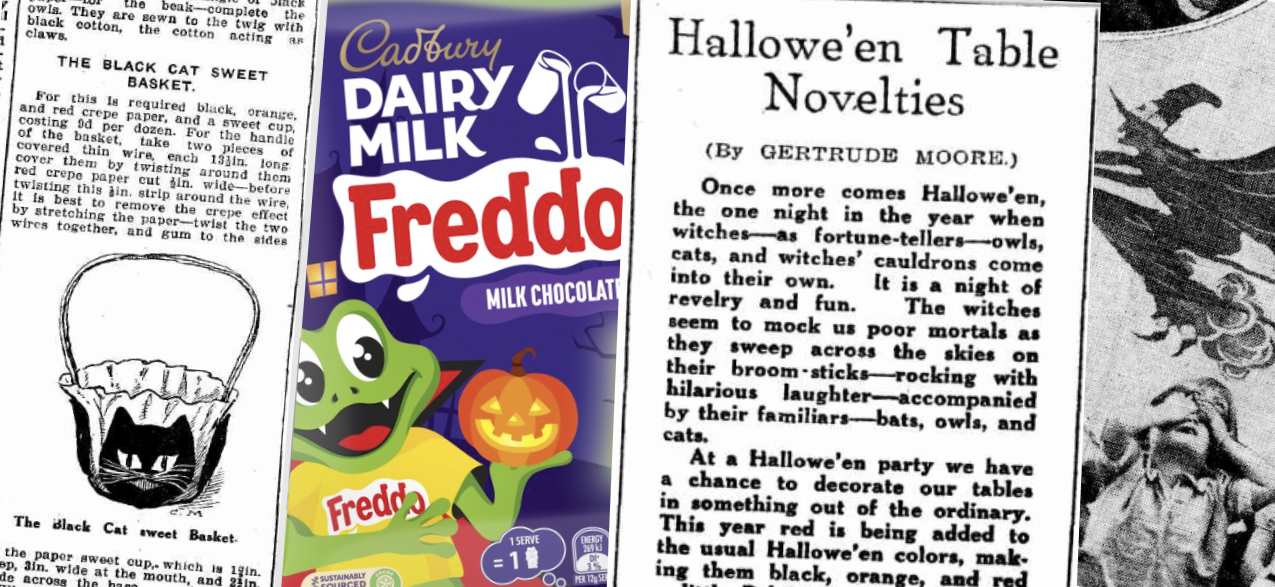
Halloween grew more and more popular, and, by October, 1928, the Sydney Mail was printing a page full of practical instructions on how to make your own ‘Halloween table decorations.’
Gertrude Moore wrote: ‘October 31! How eagerly it is looked forward to, for is not this the one night in the year ‘when witches, goblins, and the imps of darkness, casting aside their dislike of us, hold their revels, and reveal the answer to the ‘ important question, ‘Whom shall we marry?’’
Gertrude explains how to make a witch, a black cat, an owl, a moon, a Jack O’ Lantern sweet basket, and a Witch’s Pumpkin, with black card, orange crepe paper and glue.
Gertrude paints a picture of Halloween in 1928: ‘Everywhere this month, do we see the Hallowe’en colours, black and orange, with a little red and green mixed; and from every table, wall, or ceiling we see solemn owls, coal-black ferocious cats with bristling whiskers, ugly witches, clinging bats, smiling Jack-o’-Lanterns, and bunchy brooms. The fortunes and superstitions allotted to the night of Hallows Eve are well known, and if used with the decorations given here, your dinner; party, supper, or dance will be of unparalleled success.’
In 1937, in Mudgee, there was a grand Halloween Ball held in the Mechanics Institute Hall. This was a masked ball with a prize of half a guinea for the best costume. A witch was advertised and a real Scots ‘spaewife’ – a fortune teller – would read your future. The advert says: ‘Midnight is the hour of mystic spell and weird enchantment when ‘ghaists and bogles’ are about.’
World War Two saw American GIs arrive in Australia. They chewed gum, played basketball, danced the jitterbug and brought their own Halloween celebrations. But it’s American movies and TV shows that have made most Australians think that Halloween is a recent import from the USA.
E.T. the Extra-Terrestrial, Mean Girls, Buffy the Vampire Slayer, Friends, The Simpsons Treehouse of Horror, Brooklyn 99, John Carpenter’s Halloween, Stranger Things and Halloweentown are just a few of the US Halloween TV and movie imports you might have seen.
But Halloween is not some American thing that only arrived in Australia a handful of years ago. Halloween has been celebrated in Australia for over 160 years.
Before Australia became a nation, before Waltzing Matilda was written, before Vegemite and thongs, before Ugg Boots and Mad Max, AC/DC and Kylie, and before the first Aussie Rules football was kicked, there were Australian Halloweens.